But those figures of low-emissions vehicle sales, published by the Society of Motor Manufacturers and Traders (SMMT), have one obvious powertrain missing: hydrogen fuel cell vehicles, or FCEVs. That’s because their numbers are so minimal that sales wouldn’t even account for 0.01% market share. In 2019, 68 FCEVs were sold, almost double that of 2018. So far this year, 19 have been registered.
But commitment to hydrogen-powered vehicles is increasing across the industry and many predict they will become as important as battery-electric vehicles (BEVs) over time, in the way that petrol and diesel have sat alongside each other for so long. Hyundai and Toyota remain the major players for now. They are the only two mainstream brands to offer hydrogen-powered cars on UK sale today: the Nexo and Mirai.
Hyundai is planning a 500,000-units-per-year production capacity of FCEVs by 2030, including cars and commercial vehicles. Toyota, meanwhile, aims to increase global production to 30,000 fuel cell stacks by the early 2020s and has started deploying its hydrogen buses, forklifts and heavy trucks in some parts of the world.
Other car makers are dipping their toes in the water. Mercedes offers the GLC F-Cell in Germany, but only on lease, and BMW plans to launch hydrogen-fuelled vehicles in some of its larger SUVs, such as the X6 and X7, from 2025.
BMW’s board member for research and development, Klaus Fröhlich, told Autocar earlier this year: “We are convinced that various alternative powertrain systems will exist alongside one another in future, as there is no single solution that addresses the full spectrum of customers’ mobility requirements worldwide.
“The hydrogen fuel cell technology could quite feasibly become the fourth pillar of our powertrain portfolio in the long term. The upper-end models in our X family would make particularly suitable candidates.”
Closer to home, it’s not just manufacturers that are committing to hydrogen investment. The government announced this summer that it was making a £73.5 million investment to develop green technologies for 10 projects, one of which is a hydrogen fuel cell prototype project with Jaguar Land Rover (JLR).
The government said: “Hydrogen can play a role as a viable fuel in the future across the automotive industry alongside battery-electric vehicles. The project will help drive significant growth and capability in fuel cell electric vehicle design and manufacturing, providing a competitive edge in intellectual property and supply chain for the UK.”
JLR’s Project Zeus, as previously reported by Autocar, aims to produce a hydrogen-fuelled Range Rover later this decade. Talking about the project, Nick Rogers, JLR engineering boss, said: “We truly believe hydrogen has a real place and opportunity – particularly in bigger vehicles.”
On its impact to UK industry, he said: “If you think of all the commodities that go into battery-electric vehicles and hydrogen vehicles, if we can manufacture those in the UK, we can create a whole ecosystem to make the UK’s life better and propel us into a world where we’re not reliant on an oil-driven economy.”
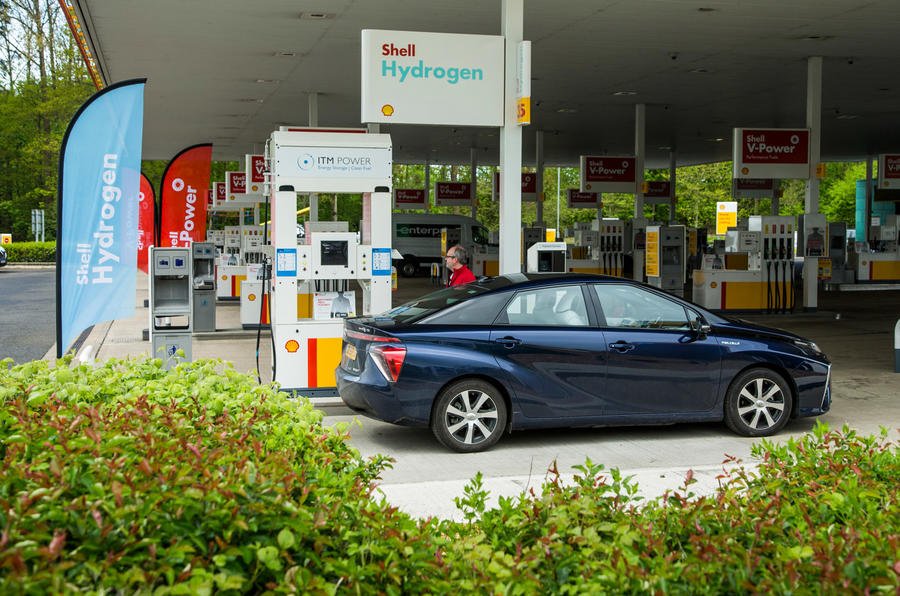
Despite this progress, FCEVs clearly are not where BEVs are today. The predominant reason is fuel cell production cost, which is still significantly higher than that of batteries. The result is expensive vehicles – for example, the Hyundai Nexo is £69,495 – which inevitably puts consumers off (although many FCEVs are leased – in the case of Nexos, half of them). The refuelling infrastructure also needs attention, with fewer than 15 refuelling points currently in the UK.
Other hurdles include concerns over the safety of hydrogen storage and the sustainability of how the hydrogen is created. Splitting water into hydrogen – the most common method of creating it – demands a lot of electricity, so it only makes sense if it’s created with renewable energy.
One clear route forward for hydrogen is in commercial vehicles. Thanks to faster refuelling (almost equivalent to petrol and diesel) and longer range than BEVs, hydrogen and commercial vehicles are a more natural fit than battery-electric. Hyundai-Kia’s FCEV R&D boss, Sae-Hoon Kim, has said: “Developing fuel cell technology for commercial vehicles is a priority for advancing the uptake of hydrogen”.
For now, some makers are only betting on hydrogen commercial vehicles. The PSA Group plans to launch a fuel cell van by 2021 that’s likely to include a Vauxhall version, but there are no hydrogen cars on the cards. PSA UK boss Alison Jones said: “At the moment, we are focused on the plug-in hybrid and battery solutions we have [for cars].”
Talking about manufacturers’ plans, SMMT chief executive Mike Hawes said: “Hydrogen will have a seat at the table in the future. We’re already seeing different manufacturers have different strategies. Some are saying electric. Some are saying electric and hydrogen. Certainly for heavier vehicles, it will be a mainstay. We’re already seeing it in some buses and larger vehicles.”
Most industry executives worldwide also believe FCEVs will break through in industrial transportation, according to KPMG’s 2020 Automotive Executive Survey. A total of 84% of players predicted hydrogen progress would first come through transport larger than cars, up 5% on 2019.
There were also regional differences found between China and Western Europe. While only 53% of Western European executives agreed that industrial transportation would provide the platform for FCEVs, 75% of Chinese executives agreed on this future development, “indicating that Chinese executives expect FCEVs to play a bigger role in an industrial context”, said KPMG.
There’s no doubt, then, that commercial vehicles will lead the way for hydrogen power, but when might we expect reasonably priced cars to battle BEVs? According to Hyundai’s Kim: “At around 200,000 units a year, you get the scale to buy the materials you need at a price that could put a hydrogen car on a cost par with today’s battery-electric vehicles. At the current rate of demand, I can see that happening within five years.”